Search results
 R30364
BR, 6000 King Class, 4-6-0, 6009 'King Charles II'
 'OO' Gauge
 Released: 23/01/25
 DCC Ready (21 Pin)
 Era 5
Era 5Between 1927 and 1930, 29 steam locomotives of the GWR Class 6000, also known as the King Class, were constructed. These engines were named after notable English kings, and this regality was reflected in their sleek angular lines and rivets that shimmered in the light. The regal class boasted taper boilers, copper-capped chimneys, and brass bonnet safety valve covers. Much of the class was in service on the West of England main line between Paddington and Wolverhampton.
No. 6009 ‘King Charles II’ was constructed in March 1928. After nationalisation in 1948, it was painted in a BR Black livery. ‘Alfloc’ water treatment was fitted in 1954 and a double chimney in May 1956. Withdrawn in September 1962, 6009 was scrapped at Cashmore’s.

Our Price:
£224.99
£224.99
 946004
B Set – BR Crimson
'OO' GaugeReleased: 03/02/25Era 4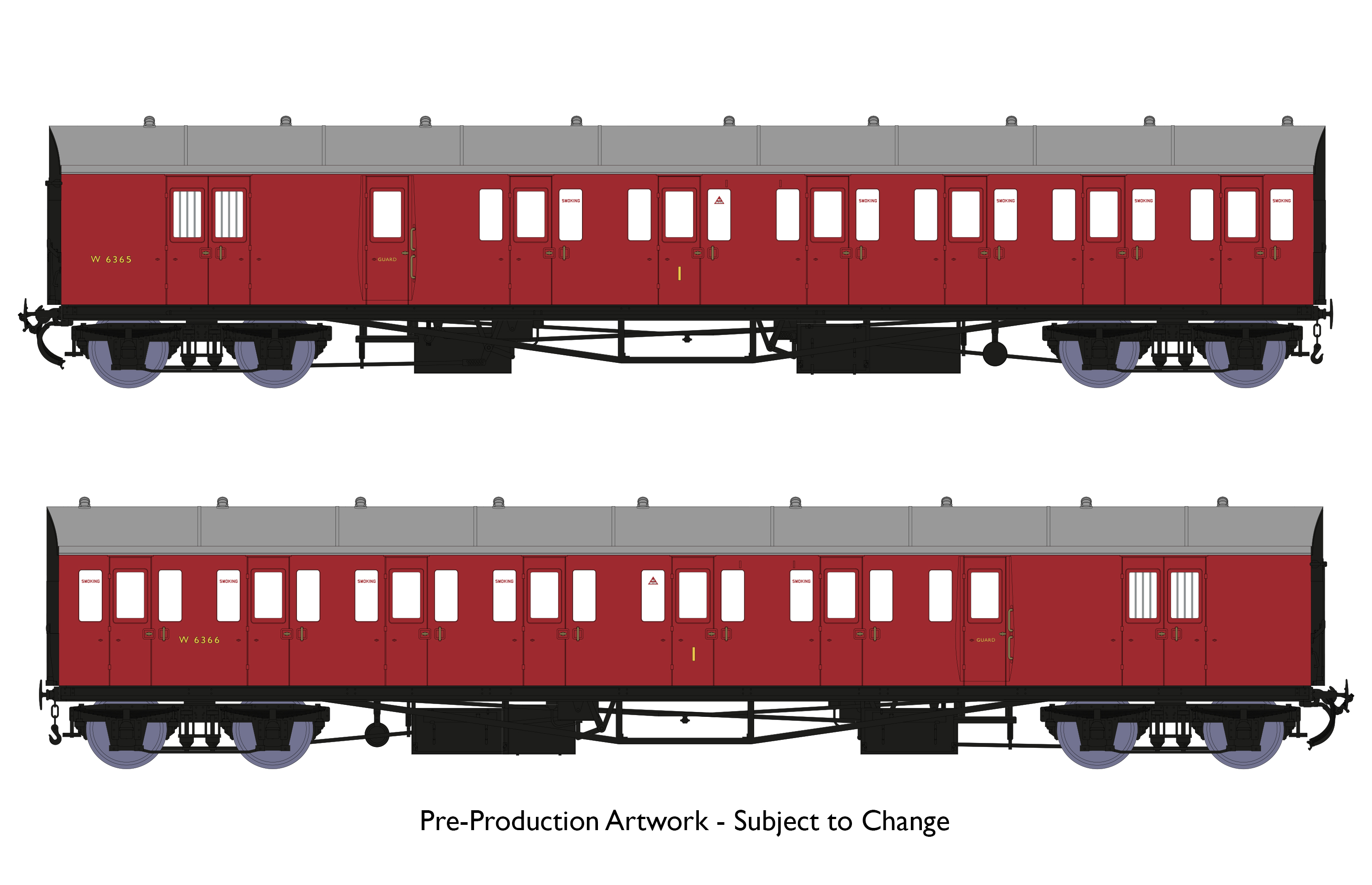
Our Price:
£144.45
£144.45
946006B Set – BR Maroon
'OO' GaugeReleased: 03/02/25Era 5
Our Price:
£144.45
£144.45
R30372GBRf, Class 67, Bo-Bo, 67027
'OO' GaugeReleased: 03/02/25DCC Ready (21 Pin)Era 11The Class 67s were constructed by Alstom Meinfesa in Valencia between 1999 and 2000 for EWS. No. 67027 ‘Charlotte’ was named ‘Rising Star’ in 2003. Various changes took place over the years. In 2007, the ownership of the locomotive was transferred to DB Cargo UK. In 2014, the locomotive adopted the DB Cargo UK red livery, changing from the previous EWS red & yellow livery.
Ownership was again transferred to Colas Rail in 2017. To reflect this, the livery was amended to Colas Rail yellow, orange and black at the Toton TMD. The locomotive name changed to ‘Charlotte’ in the same year. In 2022, ownership was transferred to GB Railfreight and repainted in a blue and yellow livery.

Our Price:
£193.49
£193.49
R3977BR, Thompson Class A2/2, 4-6-2, 60502 'Earl Marischal'
'OO' GaugeReleased: 03/02/25DCC Ready (21 Pin)Era 5Upon becoming Chief Mechanical Engineer of the LNER, Thompson sought to create an unstreamlined, mixed traffic version of Gresley's A4 Pacific locomotives. Being unable to secure permission to construct new locomotives, Thompson decided to rebuild the 2-8-2 P2 Class locomotives as the new A2/2 Class.
Thompson advocated divided drive, a system in which the middle cylinder drove the forward two of the six driving wheels whilst the outside cylinders drove the middle two. Due to his quest for standardisation, this arrangement necessitated the middle cylinder to be placed further forward than normal and the outside cylinders further back, behind the leading bogie, so that standard connecting rods could be used for all cylinders. Although the new designs retained much of the P2's power despite their lighter weight, wheel slip issues made them unsuitable for the routes the P2's had been designed for.
P2 No. 2002 'Earl Marischal' was rebuilt to become a A2/2 in June 1944, before being renumbered 502 in 1946 and 60502 upon the nationalisation of the railways. After becoming a A2/2, 'Earl Marischal' returned to Scotland before being moved south of the border to the York Shed at the end of 1949. The locomotive was withdrawn for service in 1961.

Our Price:
£251.99
£251.99
R3974LNER, Thompson Class A2/3, 4-6-2, 511 'Airborne'
'OO' GaugeReleased: 03/02/25DCC Ready (21 Pin)Era 3The A2/3 Class were designed by Edward Thompson as standard express passenger locomotives. After Sir Nigel Gresley's unexpected death in April 1941, Edward Thompson desired to standardise the locomotives of the LNER. This process involved rebuilding locomotives using standard components such as wheel sizes and boiler designs.
The A2/3 Class were new built to a similar specification to the A2/2 rebuilds, differing in cylinder sizes and boiler pressure. Thompson advocated divided drive, a system in which the middle cylinder drove the forward two of the six driving wheels whilst the outside cylinders drove the middle two. Due to his quest for standardisation, this arrangement necessitated the middle cylinder to be placed further forward than normal and the outside cylinders further back, behind the leading bogie, so that standard connecting rods could be used for all cylinders.
LNER No. 511 'Airbourne' was built at Doncaster Works and entered service in July 1946. After nationalisation, it was renumbered 60511 and assigned to the Heaton engine shed. It was withdrawn in November 1962.

Our Price:
£251.99
£251.99
 7S-094-001
J94 AUSTERITY LNER BLACK '8006'
'O' GaugeReleased: 14/02/25DCC Ready (21 Pin)Era 3
Our Price:
£229.50
£229.50
7S-094-003J94 AUSTERITY BR BLACK EARLY CREST '68030'
'O' GaugeReleased: 14/02/25DCC Ready (21 Pin)Era 4
Our Price:
£229.50
£229.50
7S-094-006J94 AUSTERITY WEMYSS WPR LINED BROWN No.15
'O' GaugeReleased: 14/02/25DCC Ready (21 Pin)
Our Price:
£229.50
£229.50
7S-094-009J94 AUSTERITY MECH. NAVVIES RED '71515'
'O' GaugeReleased: 14/02/25DCC Ready (21 Pin)
Our Price:
£229.50
£229.50